Changelog
Every release of mlx-graphs, newest first, with the notes of its GitHub release and, for some versions, hand-written notes from CHANGELOG.rst. The packages are on PyPI.
0.6.1
Performance
- loaders: sample directly from memory-mapped CSC (#229)
Other
- ci: remove the one-off scheduled release of 24 November (#227)
0.6.0
Large graphs
- Datasets:
Reddit,Reddit2,Flickr,Yelp,AmazonProductsandPPI, with PyG's files, edges, labels and splits (checked equal to PyG's,benchmarks/quality/dataset_parity.py). Single large graphs are stored as safetensors after processing.PPIis read from the GraphSAGE release, as DGL's server is down. - Temporal sampling:
NeighborLoaderandLinkNeighborLoadertake PyG'stime_attr,input_time/edge_label_timeandtemporal_strategy("uniform"/"last"): only neighbors not later than their seed are sampled, with node- or edge-level timestamps, each seed getting its own subgraph (disjoint=True, also available without time). Implemented as a vectorized numpy sampler;"last"gives the same mini-batches as PyG with pyg-lib. - Feature and graph stores:
FeatureStore/GraphStore(PyG's remote backend API) with in-memory and on-disk (MemmapFeatureStore,MemmapGraphStore) implementations.NeighborLoader((feature_store, graph_store), ...)gathers only the rows of the sampled nodes, so node features larger than the memory can be used for training.
Features
- Temporal Graph Benchmark (TGB) datasets:
TGBLinkPropPredDataset(tgbl-wiki,tgbl-review,tgbl-coin,tgbl-comment,tgbl-flight) with TGB's chronological splits and precomputed one-vs-many negative samples (TGBNegativeEdgeSampler), andTGBNodePropPredDataset(tgbn-trade,tgbn-genre,tgbn-reddit,tgbn-token) with its label stream.TGBEvaluatorcomputes MRR / Hits@k and NDCG@10 as py-tgb. The events, splits, negative samples and labels oftgbl-wiki,tgbl-review,tgbn-tradeandtgbn-genrewere checked to be identical to py-tgb's. New examplestgn_tgbl.pyandtgn_tgbn.pytrain TGN with the TGB protocol (compared with py-tgb's PyG examples inbenchmarks/tgn_comparison).
New API
-
Hierarchical and dense pooling, checked against PyG (outputs, auxiliary losses and gradients) and by training on PROTEINS in both frameworks (
benchmarks/quality/pooling_quality.py):- dense pooling
dense_diff_pool,dense_mincut_poolandDMoNPooling, with the dense layersDenseGCNConv,DenseSAGEConv,DenseGINConvandDenseGraphConv; - sparse hierarchical pooling
EdgePooling(withunpool),ASAPooling,MemPoolingandPANPooling(withPANConv), and theGraphUNetmodel; GCNConv(improved=True)(self-loops of weight 2).
- dense pooling
Point clouds and meshes
- Layers
PointNetConv(aliasPointConv),PointTransformerConv,PPFConv,XConv,SplineConv(B-spline basis in MLX, any degree up to 3),GMMConvandFeaStConv, checked against PyG with copied weights (outputs and gradients). - Sampling and clustering:
fps(farthest point sampling, one Metal threadgroup per point cloud; the same points as PyG withrandom_start=False),voxel_grid,nearest,graclus(parallel matching),consecutive_cluster, and the cluster poolingsavg_pool,max_pool,avg_pool_xandmax_pool_x. - Transforms
SamplePoints,FixedPoints,NormalizeScale,Center,LinearTransformation,RandomJitter,RandomRotate,RandomScale,FaceToEdge,Cartesian,Distance,PolarandPointPairFeatures. - Datasets
ModelNet(ModelNet10 and ModelNet40) andShapeNet(part segmentation, downloaded from a Hugging Face mirror since the original URL is offline). GraphDatagets its number of nodes fromposwhen it has no node features, and offsets mesh trianglesfacein batches, as PyG does.benchmarks/quality/pointcloud_quality.pytrains PointNet++ and DGCNN on ModelNet10 with mlx-graphs and PyG.
Added
- Molecular and 3D models, checked against PyG with copied weights (outputs and
gradients) and by training both on QM9 and ESOL
(
benchmarks/quality/molecular_quality.py):SchNet,DimeNet,DimeNetPlusPlusandAttentiveFP. - Molecular datasets matching PyG's:
QM9,ZINC(subset and full) andMoleculeNet(ESOL, FreeSolv, Lipophilicity, BACE, BBBP, HIV, Tox21, ...). from_smiles,to_smiles,from_rdmolandto_rdmolwith PyG'sx_map/e_mapfeaturization (rdkitis an optional dependency).
What's Changed
- ci: release once a day instead of on every merge by @TristanBilot in #221
- feat(datasets): Temporal Graph Benchmark (TGB) datasets and evaluator by @TristanBilot in #218
- feat: large-graph support (Reddit, PPI, Flickr, Yelp, temporal neighbor sampling, memory-mapped feature store) by @TristanBilot in #217
- feat(nn): hierarchical and dense pooling (DiffPool, MinCut, DMoN, EdgePooling, ASAPooling, MemPooling, PANPooling, GraphUNet) by @TristanBilot in #215
- ci: run the daily release at midnight UTC instead of 23:00 by @TristanBilot in #224
- feat: point clouds and meshes (fps, voxel_grid, PointNetConv, PointTransformerConv, SplineConv, ModelNet, ShapeNet) by @TristanBilot in #220
- feat: molecular and 3D GNNs (SchNet, DimeNet++, AttentiveFP, QM9, ZINC, MoleculeNet) by @TristanBilot in #219
- docs: rebuild the documentation site on Zensical by @TristanBilot in #223
- ci: run the daily release at 00:17 UTC, off the hourly peak by @TristanBilot in #226
- docs: give the site an .ico favicon and type its SVG icon, for Safari by @TristanBilot in #225
Full Changelog: v0.5.3...v0.6.0
0.5.3
What's Changed
Full Changelog: v0.5.2...v0.5.3
0.5.2
Documentation
- The G-reasoner and QM9 notebooks are now listed with the other tutorials.
The Examples page only lists the scripts of the
examples/folder.
What's Changed
Full Changelog: v0.5.1...v0.5.2
0.5.1
What's Changed
- perf(nn): fused attention for TransformerConv via mlx_cluster.edge_scores by @vinayhpandya in #206
Full Changelog: v0.5.0...v0.5.1
0.5.0
What's Changed
- feat(algorithms): add MetaPath2Vec for heterogeneous graph embeddings by @vinayhpandya in #204
Full Changelog: v0.4.0...v0.5.0
0.4.0
What's Changed
- feat: Fuse CSR softmax with sparse value aggregation by @francescofarina in #208
Full Changelog: v0.3.0...v0.4.0
0.3.0
What's Changed
- feat(nn): fuse GATv2 edge scores and gradients on Metal by @francescofarina in #207
Full Changelog: v0.2.3...v0.3.0
0.2.3
Documentation
- A Graph RAG tutorial that runs the released G-reasoner checkpoint with a custom Metal kernel and uses it as the retriever of a local LLM.
What's Changed
Full Changelog: v0.2.2...v0.2.3
0.2.2
Documentation
- A cybersecurity tutorial with four cases: host intrusion detection on DARPA TC E3 CADETS provenance graphs (Orthrus, Velox), anti-money laundering on Elliptic, network intrusion detection on NF-UNSW-NB15-v3 (E-GraphSAGE) and malware classification on MalNet-Tiny (GIN, GraphGPS).
What's Changed
- docs(tutorials): add a cybersecurity tutorial with four cases by @TristanBilot in #212
Full Changelog: v0.2.1...v0.2.2
0.2.1
What's Changed
- ci: automate PyPI releases by @francescofarina in #210
Full Changelog: v0.2.0...v0.2.1
0.2.0: PyG parity
Detailed notes (CHANGELOG.rst)
This release brings mlx-graphs close to PyTorch Geometric in features and API:
about 235 new public classes and functions, samplers and loaders for mini-batch
training, heterogeneous and temporal graphs, graph transformers, and 18 new
datasets. Every addition was checked against PyG: layers with copied weights
(outputs and gradients), samplers statistically, and models by training them in
both frameworks on the same data (benchmarks/quality/).
Highlights
- Samplers and loaders:
LinkNeighborLoader,HGTLoader,ClusterData/ClusterLoader, the GraphSAINT samplers,ShaDowKHopSampler,RandomNodeLoader,ImbalancedSampler,DynamicBatchSampler,DataListLoader,DenseDataLoader;Dataloadergainsdrop_last,follow_batch,sampler,batch_sampler,transformandcollate_fn. - Heterogeneous graphs:
to_heteroandto_hetero_with_basesturn a homogeneous model into a heterogeneous one, as in PyG (withouttorch.fx: see the docstring for the supported model patterns);HANConv,HGTConv,RGATConv,FastRGCNConv; theOGBMAGdataset. - Temporal graphs:
TemporalData,TemporalDataLoader,TGNMemoryand its building blocks,LastNeighborLoader,JODIEDataset, and the newmlx_graphs.metricspackage (link prediction ranking metrics, AUC, AP). - Graph transformers:
GPSConv,SGFormer,Polynormer,MultiheadAttention,PerformerAttention, positional encodings (LapPEEncoder,RWSEEncoder,PositionalEncoding,TemporalEncoding),LRGBDatasetandGNNBenchmarkDataset. - Aggregations: the
mlx_graphs.nn.aggrmodule (sum, mean, max, min, mul, var, std, median, quantile, softmax, power mean, LSTM, GRU, set transformer, graph multiset transformer, sort, MLP, LCM, deep sets, equilibrium, degree scaler, ...).MessagePassing(aggr=...)accepts a name, a list of aggregations (concatenated or combined withaggr_kwargs={"mode": ...}) or anAggregationmodule. - PyG names:
GraphDatahas thex,edge_attrandyaliases,GraphDataBatchhasbatchandptr, and the norm layers are also exported under their PyG names (GraphNorm,PairNorm, ...). -
Documentation:
- new tutorials, each compared with PyG on accuracy and runtime: mini-batch
training on large graphs, link prediction, temporal graph networks,
heterogeneous graphs with
to_hetero, and graph transformers with GPS; node2vec is now a single tutorial; - new pages: "Creating message passing layers" (user guide) and "Validation against PyG"; an updated "Coming from PyTorch Geometric"; an overview figure at the top of every tutorial.
- new tutorials, each compared with PyG on accuracy and runtime: mini-batch
training on large graphs, link prediction, temporal graph networks,
heterogeneous graphs with
New API
-
mlx_graphs.nn:-
Message passing layers:
AGNNConv,ARMAConv,CGConv,ClusterGCNConv,DirGNNConv,DynamicEdgeConv,ECConv,FAConv,FastRGCNConv,FiLMConv;GCN2Conv,GENConv,GINEConv,GPSConv,GatedGraphConv,GeneralConv,HANConv,HGTConv,LEConv,LGConv,MFConv;MixHopConv,NNConv,PNAConv,RGATConv,ResGatedGraphConv,SSGConv.
-
Models:
PNA,EdgeCNN,DeepGCNLayer,LINKX,LightGCN,LabelPropagation,CorrectAndSmooth,MaskLabel,RECT_L;- graph autoencoders:
GAE,VGAE,ARGA,ARGVA,InnerProductDecoder; DeepGraphInfomax;- knowledge graph embeddings:
KGEModel,TransE,DistMult,ComplEx,RotatE,KGTripletLoader; SGFormer,Polynormer,TGNMemory.
-
Norms:
BatchNorm,InstanceNorm,LayerNorm,GraphNorm,PairNorm,DiffGroupNorm,MessageNorm,MeanSubtractionNorm,GraphSizeNorm,HeteroBatchNorm,HeteroLayerNorm. - Pooling and graph construction:
TopKPooling,SAGPooling,global_sort_pool,knn,knn_graph,radius,radius_graph.
-
-
mlx_graphs.transforms:AddLaplacianEigenvectorPE,AddRemainingSelfLoops,FeaturePropagation,IndexToMask,KNNGraph,LineGraph,LocalDegreeProfile,MaskToIndex,NormalizeFeatures,RadiusGraph,RemoveDuplicatedEdges,RemoveTrainingClasses,SIGN,SVDFeatureReduction,TargetIndegree,ToDense,TwoHop,VirtualNode. -
mlx_graphs.utils:- graph generators;
- subgraph, mask and self-loop helpers;
- negative sampling for batches;
get_ppr;assortativity,normalized_cut;- scipy conversions;
- the
scatterreductionsvar,std,mul,medianandquantile.
-
mlx_graphs.datasets:- citation and web graphs:
CitationFull,CoraFull,WikiCS,WebKB,WikipediaNetwork,Actor,HeterophilousGraphDataset; - knowledge graphs:
FB15k_237,WordNet18,WordNet18RR; - synthetic graphs:
FakeDataset,FakeHeteroDataset; JODIEDataset,LRGBDataset,GNNBenchmarkDataset,OGBMAG;- a torch-free reader for
.ptfiles (load_torch_file), which uses a restricted unpickler.
- citation and web graphs:
-
Dataset,GraphDataandHeteroGraphDatagain PyG conveniences, among themnum_classes(inferred as in PyG),shuffle,to_homogeneousand the feature counts.
Changes that can affect existing code
-
Self-loops now default to PyG's behaviour.
GCNConvdefaults toadd_self_loops=True(it wasFalse).GATConvandGATv2Convgainadd_self_loops=Trueandfill_value="mean".- To keep the previous results, pass
add_self_loops=False.
-
GIN: theactandnormarguments now also apply to the MLP inside everyGINConv, as in PyG. Before, that MLP always used ReLU and no normalization.- Models with the defaults (
act="relu",norm=None) are unchanged. - With
norm="batch"or"layer", the MLPs gain norm layers, so weights saved before this change will not load as-is.
- Models with the defaults (
-
GAT:dropoutnow also applies to the attention coefficients of everyGATConv/GATv2Conv, as in PyG'sGAT. Before, it only applied between layers. Models withdropout=0are unchanged. -
LayerNormalization:mode="graph"(the default) was broken and now matches PyG'sLayerNorm.mode="node"now uses the layer's ownweightandbias. Its unusedlayernorm.*parameters are gone, so older checkpoints do not load strictly.
-
Index dtypes are int32 throughout. This covers:
- the
n_id,e_idandedge_indexreturned byNeighborLoader; GraphDataBatch.batch_indices,batchandptr;- the
follow_batchvectors.
Indexing with them works as before. int64 is used only for graphs with more than 2^31 - 1 nodes or edges.
- the
-
GraphDataBatchindexes like a Python list of graphs.- Slices are clipped instead of raising:
batch[:101]on a smaller batch, orbatch[3:2], which gives[]. - Negative steps work.
batch[num_graphs]raisesIndexError.- Index arrays, lists and boolean masks are accepted.
- Slices are clipped instead of raising:
-
MessagePassing(aggr="softmax")is now the softmax aggregation (SoftmaxAggregation), as in PyG and asaggr=["softmax", ...]already was. Plain string aggregations given withaggr_kwargsnow use them instead of ignoring them. -
Max and min aggregations split the gradient equally among tied values, as PyG does (e.g. with duplicate edges). Before, every tied value got the full gradient. The backward pass of the fused max/min kernels is slower as a result; forward passes are unchanged.
-
Initialization:
HeteroDictLinearnow initializes liketorch.nn.Linear, as in PyG, instead of Glorot.
Fixes to previously released code
SAGEConvwith a max, min, std or list aggregation and more input than output features projected before aggregating (max(Wx)instead ofW max(x)).SAGEConvgains PyG'sroot_weight. Without it,DirGNNConv(SAGEConv)kept a root projection in both directions and trained 2-3 points below PyG.TUDatasetdropped edge labels.IMDBkeyed its labels by"movies"instead of the"movie"node type.NeighborLoaderwith out-of-range seed nodes read past the sampler's buffers. It now raisesIndexError.- Batching graphs whose first graph has no nodes broke the edge offsets.
- Unbatching turned int32
edge_indexinto int64. - QM7b downloads failed: the old http URL returns 400. It now uses PyG's https URL.
- Tar extraction is now protected against path traversal and symlink escapes.
Tips when porting PyG code
mlx.optimizers.Adamhas no bias correction by default, unliketorch.optim.Adam. UseAdam(learning_rate=..., bias_correction=True)to train the same way.- Batches of graphs of varying sizes create arrays of many different shapes.
To bound memory, cap MLX's buffer cache with
mx.set_cache_limit(...).
Known limitations
-
to_hetero:- It does not detect operations that mix rows across node types inside the
model's
__call__(e.g.x.mean(0), sorting). PyG traces these per node type. - Copies without a
reset_parameters()method are re-initialized by shuffling their weights.
- It does not detect operations that mix rows across node types inside the
model's
-
GPS, SGFormer, Polynormer and the LSTM, GRU, set transformer and sort aggregations read the batch layout on the host. They work with
nn.value_and_gradbut not withmx.compile, unless the precomputedlayout=argument is given (GPS, SGFormer, Polynormer). TGNMemory's memory is not saved bysave_weights. Usememory_state()andload_memory_state().- MLX 0.32.4 crashes when a compiled activation is applied to an empty matmul
result.
CGConv,NNConvandEdgeConvare guarded against it. Most layers still fail on graphs with zero nodes.
Summary
This brings mlx-graphs close to PyTorch Geometric in features and API, as release 0.2.0. It adds about 235 public classes and functions, each checked against PyG. The full list is in CHANGELOG.rst, which the docs show as the Changelog page.
- Mini-batch training:
LinkNeighborLoader,HGTLoader,ClusterData/ClusterLoader, the GraphSAINT samplers,ShaDowKHopSampler,RandomNodeLoader,ImbalancedSampler,DynamicBatchSampler,DataListLoader,DenseDataLoader.Dataloadergainsdrop_last,follow_batch,sampler,batch_sampler,transformandcollate_fn.
- Heterogeneous graphs:
to_heteroandto_hetero_with_bases(withouttorch.fx),HANConv,HGTConv,RGATConv,FastRGCNConv,OGBMAG. - Temporal graphs:
TemporalData,TemporalDataLoader,TGNMemory,LastNeighborLoader,JODIEDataset, and a newmlx_graphs.metricspackage with ranking metrics, AUC and AP. - Graph transformers:
GPSConv,SGFormer,Polynormer,MultiheadAttention,PerformerAttention, and positional encodings (AddLaplacianEigenvectorPE,RWSEEncoder,LapPEEncoder). - Layers and models:
- 26 new convolutions;
- aggregation modules, usable in
MessagePassing(aggr=...)by name, as a list or as a module; - 11 norms, plus TopK / SAG pooling;
- autoencoders,
DeepGraphInfomax, knowledge-graph embeddings,LINKX,LightGCN,CorrectAndSmooth,PNA,EdgeCNN, and more.
- Transforms, utilities and 18 datasets.
- Docs:
- seven tutorials (each compares accuracy and runtime with PyG);
- a guide to writing message passing layers;
- a "Validation against PyG" page;
- an examples index;
- the changelog;
- an updated "Coming from PyTorch Geometric" page.
Changes that can affect existing code
The changelog explains each change and how to keep the old behaviour.
GCNConv,GATConvandGATv2Convadd self-loops by default, as in PyG. Passadd_self_loops=Falsefor the previous results.GIN:actandnormnow also apply to the MLP inside eachGINConv. Models with the defaults are unchanged.GAT:dropoutnow also applies to the attention coefficients.LayerNormalization:mode="graph", the default, was broken; it now matches PyG.mode="node"no longer has its unusedlayernorm.*parameters.
- Index arrays are int32 throughout:
NeighborLoaderoutputs,GraphDataBatch.batchandptr. GraphDataBatchindexing behaves like a Python list: slices are clipped,batch[num_graphs]raisesIndexError, and masks and index arrays work.aggr="softmax"is nowSoftmaxAggregation.- Max/min aggregations split the gradient among tied values, as PyG does. The fused backward pass is slower as a result; forward passes are unchanged.
HeteroDictLinearinitializes liketorch.nn.Linear.
Fixes to released code
SAGEConvprojected before aggregating for max, min, std and list aggregations.SAGEConvgainsroot_weight. Without it,DirGNNConv(SAGEConv)trained 2–3 points below PyG.TUDatasetdropped edge labels.IMDBkeyed its labels by the wrong node type.NeighborLoaderread out of bounds on out-of-range seeds.- Batching broke edge offsets when the first graph was empty.
- QM7b downloads failed.
- Tar extraction allowed path traversal.
Validation
- Layers: every layer is tested against PyG with copied weights, comparing outputs and gradients. Samplers are tested statistically.
- Training (
benchmarks/quality/, results on the Validation page):- Models are trained in both frameworks on the same data and splits.
- Node level: 96 of 99 configurations match PyG. Of the other three, two are PNA runs, which are unstable in both frameworks, and one is DirGNN(GCN) on CiteSeer, where mlx-graphs scores higher.
- Graph level: 34 of 34 configurations match.
- TGN, GPS and
to_heterocomparisons are inbenchmarks/tgn_comparison,benchmarks/gps_peptidesandbenchmarks/to_hetero.
Test plan
-
pytest: 3109 passed, 54 skipped. -
pytest --datasets tests/nn/test_to_hetero.py(DBLP / IMDB parity): 41 passed. -
pre-commit run --all-files: ruff, ruff-format, yaml, end-of-file, whitespace. - Sources parse under Python 3.10 grammar (CI tests 3.10–3.12).
- Sphinx build: 0 warnings, 571 pages. Every notebook has stored outputs, so nbsphinx does not execute them in
publish_docs.yml.
Links from the docs to files on main (result tables, examples) resolve once this is merged.
0.1.0
mlx-graphs 0.1.0: faster message passing, PyG-parity layers and models, PyG benchmarks
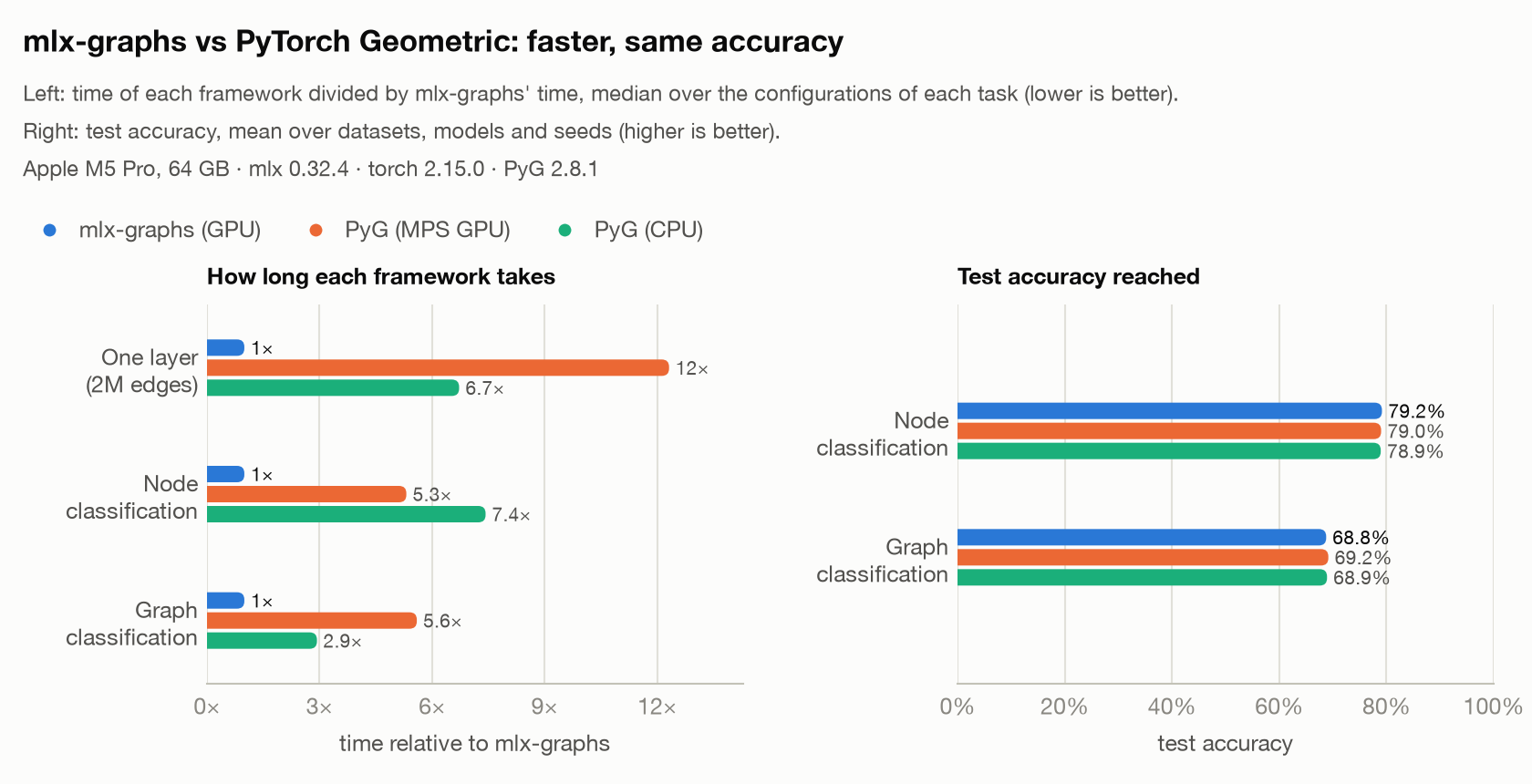
On an M5 Pro, mlx-graphs now trains GNNs 5.6× faster than PyTorch Geometric on MPS and 5.8× faster than on CPU, with the same accuracy (median of 35 training benchmarks on 12 datasets, up to 58×). Compared with 0.0.11 (current main), a single layer is 1.5–2.7× faster on large graphs.
Performance
- Fused message passing: layers whose message is a weighted sum of neighbour features aggregate with one sparse × dense matmul on the GPU (
mlx-clusterkernels) instead of gather-scatter, so the[num_edges, features]message array is never built. This includes GAT/GATv2 (one SpMM per head).format="auto"switches from COO to the faster CSR kernel when the conversion pays off; it can be turned off globally or per block of code. - Cached GCN normalization for GCN, SGConv, APPNP, TAGConv and ChebConv on a fixed graph.
- Vectorized
coalesce,to_undirected, batching/collate andscatter_softmax.
New features
- Layers:
TransformerConv,GraphConv,SGConv,APPNP,ChebConv,TAGConv,EdgeConv,RGCNConv. - Models:
GCN,GraphSAGE,GIN,GAT(v1/v2),MLP, with dropout, batch/layer norm and Jumping Knowledge. - Pooling / readout:
AttentionalAggregation,Set2Set,JumpingKnowledge. - Transforms:
Compose, structure transforms (self-loops, undirected, isolated nodes, largest connected component, …),RandomNodeSplit,RandomLinkSplit, feature transforms (OneHotDegree,Constant,AddRandomWalkPE,GCNNorm). - Utilities:
subgraph,k_hop_subgraph, negative sampling,dropout_edge/dropout_node,to_dense_batch,to_dense_adj,get_laplacian,homophily,from_pyg/to_pyg. - Datasets: Amazon (Computers, Photo) and Coauthor (CS, Physics).
Fixes
- Layers are initialized as in PyG (Glorot for GCN/GAT, PyTorch's default
Linearinit for GraphSAGE/GraphConv). GraphSAGE no longer collapses on Amazon: 72% → 91% test accuracy on Photo, 63% → 78% on Computers. - GAT attention vectors use Glorot initialization.
Dataloaderreshuffles on every pass and has alen()(number of batches).
Behaviour changes
Code written for 0.0.11 may behave differently:
- Layers initialize as in PyG, so trained results can differ slightly.
coalescesorts edges by (source, destination) and no longer swaps the rows ofedge_index.Dataloaderreshuffles on every pass whenshuffle=True.- Requires
mlx>=0.32andmlx_cluster>=0.1.2. Dependencies are now minimum versions instead of exact pins.
Benchmarks against PyG
benchmarks/pyg_comparison compares mlx-graphs with PyG on MPS and on CPU, using the same models, data and hyperparameters:
- Tasks: single layers on graphs of up to 2M edges, full-batch node classification on 8 datasets (Cora to ogbn-arxiv), graph classification on 4 TU datasets.
- Training quality: training loss at every epoch and test accuracy over 3 seeds, so the comparison shows the models learn the same, not only that they run faster.
- Isolation: each configuration runs in its own process under a 16 GB memory cap.
- Version tracking: results are stored per version (
results/<chip>/<version>-<commit>/), andhistory.pycompares versions (0.0.11 → 0.1.0 inhistory.md).
Docs and README
- README: new header with badges, the headline result and figure, and an updated benchmark section with the loss and accuracy curves.
- Docs:
- new Benchmarks page (figures only, generated by
plot.py); - new tutorial Coming from PyTorch Geometric;
- Quickstart gains a models-and-training section;
- the Graph Classification notebook is fixed and re-executed;
- Amazon and Coauthor are on the Datasets page;
- docs build warnings go from 55 to 2.
- new Benchmarks page (figures only, generated by
Testing
- 1,316 tests pass. They include parity tests against PyG for layers and models, and fused vs gather-scatter equivalence.
- The 0.1.0 sdist and wheel build and pass
twine check. The wheel installs in a fresh environment.
Release
The version is bumped to 0.1.0. After merging, publishing a GitHub release tagged v0.1.0 publishes to PyPI and rebuilds the docs.
0.0.11
- added fused message passing (SpMM) for GCNConv, SAGEConv, GINConv and SimpleConv (#193)
- added heterogeneous graph training: HeteroNeighborLoader, HeteroConv, HeteroDictLinear (#192)
- fixed Node2Vec: rowptr for nodes without outgoing edges (#195), random walks with walks_per_node > 1, p/q sampling on GPU (#201)
- fixed scatter max and min edge cases (#191)
- fixed batching of graphs with isolated nodes (#196)
- requires mlx_cluster>=0.1.2
0.0.10
- fixed some security issues
- added hetero graph normalization
- added some docs on datasets
0.0.9
- add neighbor loader for graph processing
- bump numpy dependency
0.0.8
- Gatv2
- Heterogeneous data
0.0.7
- support for heterogeneous data
- IMDB and DBLP dataset
0.0.6
- Normalization layers
- Additional properties for
GraphData GINElayer- conversion to and from
networkx - minor fixes
Breaking:
edge_indexis now required when instantiating aGraphData
0.0.5
- Processed datasets are now saved for fast reload
transformoperation available on datasets- New datasets:
EllipticBitcoinDataset,PlanetoidDataset,OGBDataset - New layers:
SimpleConv - Fix
TUDataset
0.0.4
- New
SuperPixelDataset - New
GeneralizedRelationalConvlayer - Conversion to
networkx - Fix
TUDataset - Additional benchmarks and various improvements
0.0.3
- Add
Datasetclass and initial datasets, includingTUDatasetandQM7bDataset - Add
Dataloader - Improve collate
- New convolutional layers
- Benchmarking and increased speed (up to 10x wrt other frameworks) thanks to faster gather and scatter ops in mlx
0.0.2
Update installation instructions and docs